Wednesday, June 26, 2013

An Art Project Good for Ages 5 to 64--Step by Step

The artist has to look at life as he did when he was a child. If he loses that faculty, he cannot express himself in an original, that is, a personal way. (Henri Matisse)

Today I was trying to think up an art project that would work for both my 5 year-old grandson and my 8 year-old granddaughter. Using a light box seemed like something they could both use for tracing, and sharpies are always fun no matter what age. I put those two activities together with the concept of creating a self-portrait. To my delight, the children rose well-above my expectations. Noah's self-portrait is above. His less steady hand and creative framing made his art so authentic. Then his idea of coloring his lips red, really perfected this sweet picture in my eyes.


The first step was choosing a photograph from the many we have on the computer and printing a full sheet. Next we did a simple outline of the head, hair, facial features and shoulders directly on top of the photo.

The next step was setting up my large light box on the studio floor where we could all sit around and trace the felt-tip markings on our photos onto nice drawing paper. We did this in pencil, so any errors could be erased. After we had our pencil drawings, we went over the pencil lines with felt-tips.

The final part was decorating our portraits, making frames or designs or patterns. This was a very unscripted part and the children followed their own ideas.


Marin enjoyed this so much she decided to do another portrait using the same method, but this time using watercolors to finish her picture.


At the end of the day, we played around substituting our portraits for our heads in these photos.


Sunday, June 23, 2013

May 2013 Trip, Part III--Many Ports then Back to England

My sister Barbara and I visited many ports on our cruise leaving from Southampton, England. We first hit a port in Spain, then on to Portugal and the Canary Islands before returning to Portugal and Spain (stopping at different ports) then ending up back in England. These towns and cities were historic as well as beautiful. They all had commonalities:

Vigo, Spain

Art                                                                                           Old Areas                       
My sister Barbara in old Vigo.
The port of Vigo, Spain has this rather odd sculpture. From the back,
 it's a mystery, but walk around and you find it's a face-planted head. 


Vistas
The port of Vigo and our ship, Independence of the Seas in the background.

Lisbon, Portugal


Even the sidewalks are mosaic. 
The church entrance at the Monastery of Jeronemos,
the Maneline style is so ornate. 

Beautiful Lisbon.
Art students in the park across from the Monestary.


Lanzarote, Canary Island 
This island is unique among the Canary Islands. It is a volcanic dessert island, with almost no water or soil. It's development was greatly influenced by the Lanzarote artist, Cesar Manrique, who insisted on a limit to building height, that all buildings be painted white with blue or green trim. His art included "wind toys," paintings, sculptures, and an incredible cactus garden.

Jardin de Cactus


One section of Manrique's Cactus Garden.


Lanzarote living.


Lava tube with reflection in the collected water.


I have to admit that the rest of the Canary island ports were less distinctive and flowed into one another. A few adventures stand out, such as when an ATM ate my debit card. (Note to travelers: always take more than one card and notify your banks about your travel plans.)

The islands and ports are beautiful none the less and Barbara and I greatly enjoyed our taxi tours. Rather than going on the cruise tours, we chose to find drivers who spoke a bit of English and travel on our own.

Balcony Bouquets of Canary Islands
9x12
Hillsides are packed with colorful buildings.
Although there is some debate about how the
Canary Islands got their name, these dogs are
testament to the legend that the name comes from
"canine." One story is that the islands had native dogs
when first contacted by the Romans.

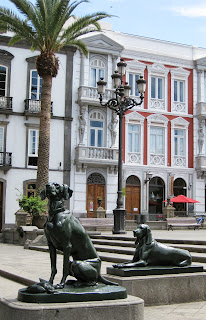
Catedral de Santa Ana, established in 1478, just a few
years after Columbas headed toward America.
Many explorers, including Columbus,
used the Canary Islands as a respite from the seas.
Barbara and our taxi drivers at another vista.


Madeira, Portugal


One of the many painted doors in Funchel.


The doors in the historic area of Funchel, Madeira were painted in 2011 during a project to promote art in the city.
Fishermen hanging out.
Ceiling in a small chapel.
In a small fishing village we visited a very humble (from the outside) chapel dedicated to the fishermen in the area. Inside was this fabulous painted ceiling.


La Caruna, Spain
In our last port, La Caruna, we celebrated Barbara's birthday. The day was rainy and we were fairly worn out after our 2 weeks of port-hopping. We settled for a nice lunch and a walking tour.

Barbara's birthday lunch.
La Caruna


We wrapped up our trip with 2 days in London. We saw "Wicked" and "Billy Elliot," both in theaters within walking distance of our hotel. Our last day we spent at the Victoria and Albert Museum which is a truly amazing museum.

What a wonderful trip!

Tuesday, June 11, 2013

May 2013 Trip, Part II--Teaching Art on a Cruise

The most fun part of teaching an art class on a cruise is meeting interesting people. However, there are  some limiting factors to teaching on a ship. The class runs about one hour and is held in a room with plenty of seating, but small round tables. (Both cruises I've been on have held the classes in a large lounge.) Also, participants run from total beginners to quite experienced artists, so the project has to have some sophistication, yet be adaptable to the simpler activity of learning to use paints.

After my first experience of teaching watercolor classes on my cruise to Alaska last May, I realized I could help participants have a much better experience with some organizational changes. It also improved my experience because everything ran so smoothly!
  • The best "new thing" was using my iPad which had 2 to 4 minute demonstrations of each project. I simply connected the iPad to the ship's digital projector and "viola" the entire project, start to finish, was projected on a large screen.
  • Because of the limited time and the fact that many people have difficulty doing a drawing, I had each landscape and floral project lightly sketched on watercolor paper. 
  • I was prepared for 50 students (which is what the ship requires) and knew ahead how things would be shared and what type of brushes would work best for any given project.
The first project was Paint a Card. I suggested that people choose one word to paint by charging in one color to the next, then decorate the rest of the card with "confetti" type brushmarks. You can see how creative people got with this one.


Posted by Picasa


This photo gives you a view of the workspace in the Pyramid lounge. 

This group concentrated on their work.
Everyone found success with a mosaic project.

Gentlemen can paint!
I loved the adventurous colors used by this fellow.
Posted by Picasa


It was fun to have a diverse age group.


Even Landscapes were a breeze for this group.


Posted by Picasa


I really enjoyed the family groups who came to the classes.


The final project was the one I was most concerned about. Painting a floral, and a poinsettia in particular, might be challenging for some beginners, but these participants dove into the painting and came up smiling.

Posted by Picasa

I was so happy to see Paul and Gina ( my new British BFF's) show up for my last class. After sharing so many stories and laughs each night at our dining table, I was glad they came to paint.