Saturday, April 25, 2015

A Trip of a Lifetime: Part II--Up, Up, and Away


How do you come off the high of seeing ancient tombs, temples, colossal statues while sailing down the Nile?

We spent one night at Luxor's Winter Palace Hotel built in 1886 (just yesterday compared to the antiquities of Egypt.) We enjoyed the luxury of a beautiful room decorated as one would expect in a palace and the grounds with a swimming pool and lovely gardens.


We woke up at 3:30 am to head off for our next adventure--flying over Luxor in a hot air balloon.


Our eyes practically popped out as the balloon began to fill with heat in the early dawn. We watched as others scrambled over the edge of a 4 foot tall basket. There is no door, just a couple of  holes for your feet as you climb/tumble in to the basket. 


As we watched with wonder, balloons lifted into the sky. Finally we got into our basket, had a quick photo taken, and we were off the ground.


Looking straight down at the crew and truck.

Why so early, you might ask: to see the sunrise, of course.


Hatsheput's Temple 


All along the Nile there is green with an abrupt edge to the desert.


Each balloon pilot had a ground crew speeding along along city streets and dirt roads ready to help steady the balloon once landed, retrieve the passengers, and deflate the balloon and get all the equipment into a truck.

The tricky part was for the pilot to find a field without any power lines, trees, buildings to hit with an access road (and I use the term road loosely). Where we landed, a very disgruntled land owner came out to scold and yell at our team. Luckily for young ears, we couldn't understand the language, but the anger was clear.

Thrilling is about the only word to describe this 2 hour adventure. However, more was to come. . .

After a long afternoon nap, we boarded a felluca for an "up close and personal" experience on the Nile.

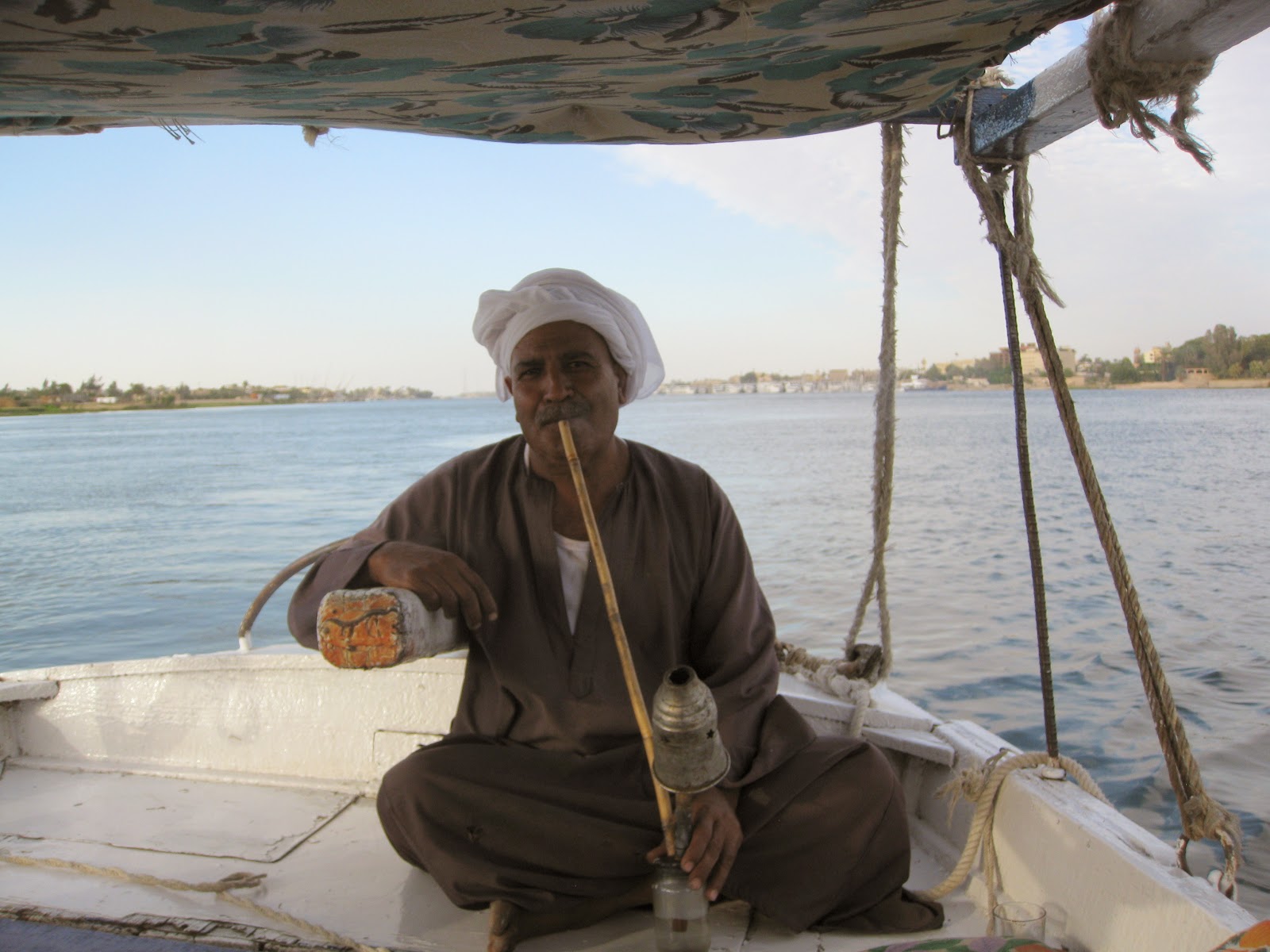
Our shisha smoking captain.


Our guide goes by the name Shakespeare. 

Felluca rigging.

An egret santuary.


The promised sunset on the Nile.
And our day ended finding our beds on the night train to Cairo.


Thursday, April 23, 2015

The Trip of a Lifetime: Part I

When you were a kid, did you dream of visiting the places you saw in National Geographic, the social studies text, or Encyclopedia Britannica?  I have held the dream of visiting Egypt since childhood. Finally, this spring I traveled to Egypt then on to Paris with my husband and granddaughter. It might not have happened if we didn't have relatives living in Cairo. My nephew helped us put together the most amazing trip to see the antiquities of Egypt, see the markets of Cairo, visit the Egyptian Museum and camp in the Sahara Desert. I'm still feeling like it was a fantasy, but here is the solid evidence it actually happened--my photos.

I am breaking this up into segments because I want to post the most memorable parts and there are just too many to include in one post. I also want to feast your eyes with photos rather than words, so here goes.

Mike and Angelica getting ready to board our cruise ship.
One of the easiest ways to see the temples and tombs along the Nile is to take a 3-7 day cruise. We had an excellent guide for our excursions. Habibi tried to stuff more history into my brain than I could collect, but it was wonderful to hear the names of the temples and Pharaohs pronounced correctly.


Mike and me on the High Aswan Dam

Completed in 1970, this dam stopped the flooding of the Nile, which was the primary reason the Egyptian Civilization began thousands of years ago.

The Dam also put many Egyptian Temples underwater. A few were laboriously moved  such as Philae Temple.


Philae Temple, once under water, has been moved to an island near Aswan.


In this Egyption Temple, built during the Greco-Roman Period (500 B.C.), there are graffities written  by French soldiers fighting for Napoleon Bonapart in the late 1700's. 

One of the gods was Sobek, the crocodile god. It was thought that the crocodiles brought the floods, or perhaps by worshiping the crocodile, one wouldn't get eaten. Either way, the custom was to capture a crocodile each year, feed and worship it until the next flood. Another croc would be captured and last years' would be mummified.


Sobek, the Crocodile God at Temple of Kom Ombo.

I loved seeing the details of the reliefs--look at the toenails!

We were hit by a mob of unruly school children. Foreigners are pretty fascinating, I guess


There is a faint glimpse of color--imagine what it looked like 2500 years ago.

Crocodile mummies.

Each night we had a beautiful sunset on the Nile.


And each day Egyptian life went on on the banks of the Nile as we floated by.


Add caption

With the heat over 100 degrees and no shade, Mike and I finally did some bartering near the temples. I got a hat for 80 Egyptian pounds (about $10.50) and Mike learned to cover his head and neck with a scarf.


Horus, the falcon god and an important god throughout most of Ancient Egyptian times. Since Horus was said to be the sky, he was considered to also contain the sun and moon.


And then there was Hatsheput, the only female pharaoh.  This large temple, carved into the mountainside is truly impressive.


Originally each huge pillar had a giant statue of Hatsheput on the front: so impressive. 


This was taken in front of the Valley of the Kings. No photography is allowed inside the tombs. The tombs are definitely some of the most memorable sites, and only a few are open to the public. I hope there are still some unearthed tombs keeping the glorious relics unharmed. 
 I'll end this section with a photo of the Colossi of Memnon, still there after 3400 years.
These colossal statues illustrate the gigantism of much of Egyptian art.


Sunday, March 15, 2015

Choosing Art Workshops: This was for fun

Whether you are a beginning or advanced artist, there are many workshop opportunities to expand your art knowledge, learn techniques, improve design and composition, or dig deeper for emotional content. When I was a beginning artist, I could make use of almost any information from a workshop, because, as a beginner, I was still searching for my own voice and my own art language and honing my skills. As I progressed and became more clear on what I had to say in my own creations, I began to realize that some workshops derailed me from my own trajectory. I would get overly influenced by a more advanced/professional artist and loose my way for awhile. It could take months to come back to my own original art-making.

Consequently, I have begun to limit myself to workshops that are: 1) mentoring in style, 2) teaching a method or technique that I already employ, 3) offering just plain fun. The marbling workshop I took from Liz Walker the past 2 days fits in the latter category. Marbling is not only fun, I now have a stack of papers to use in collage, for decorative purposes such as cards, and some to play around with as exercises with negative painting.  

The two paintings to the right, were part of day one's lesson. Liz let us choose a couple of already marbled papers to play with as she showed us ways of using a whole piece to create a painting, mostly by negative painting around the areas we wanted to keep as purely marbled. In one piece, I saw faces and figures. In the other I just wanted to preserve and enhance the beautiful marbling so I worked on a nonobjective painting.


By day two, all the workshop participants had prepared many pieces of papers to marble, which is its own process and needs to be done a day ahead of the actual marbling. After watching Liz show us several different methods of using the marbling technique, we were like horses at the starting line itching to begin.

Below are some of the examples of my own marbling. I have to tell you that I have a lot to learn and a lot of practicing to do before I could produce the kinds of papers you would buy in the art stores!


Another thing we did was marble over old paintings or starts of paintings that were either failures or uninteresting. Here are a couple examples of marbling over my own pre-painted surfaces.

There are a number of Oregon artists who very successfully take a marbled paper and create a unique piece of art by seeing subject matter in the paper, creating an abstract piece from the marbling or select parts of a paper to marble, leaving the pre-painted subject matter of the paper.

If you are interested in seeing original art using the marbling technique, check out these websites. 

http://www.lizwalkerart.com, http://www.sgreenbaumart.com/, http://www.rene-art.com

Remember my earlier comment about getting derailed? That is why I will stow away my stack of lovelies for awhile and return to the art I am already in the process of creating. The marbling will have to wait and integrate itself into my own voice and language, but boy did I have fun!


Monday, March 2, 2015

The Wonders of 300 lb. Arches

The result of many washes on 300 lb Arches
For awhile now, I've been exploring ways to create deep colors through layering highly pigmented water multiple times over multiple days. I loose count, but I think it takes 7 to 10 layers to get the depth of color I want.

In this last piece I used 300 lb. Arches watercolor paper because lighter weights have a lot of warping and buckling as I do so many very wet layers. Because I don't pre-wet and stretch my papers (too lazy and impatient) I decided to see what would happen with the stronger, thicker and tougher 300 lb paper.

As expected, the multiple layering of wet washes did not result in the buckling that occurred with lighter weight paper. There was an eventual curling of the two edges, but that didn't create the unpredictable pooling I'd dealt with using the 140 lb paper.

As the painting progressed into the rocks and sand, I got much too much paint on the sandy portion in the lower part of the painting. I had created a very consistently mid-value area which required scrubbing out (making the sand lighter) with my sponge. Not a problem with the 300 lb paper. Then I realized that I needed to add washes over the sandy area to get a unity with the teal blue water. I worried my scrubbing would have created too much pilling and nubbing of the paper, but no. New washes went on like a dream.

I then realized I needed to create life and light on the rocks. Again this paper really took the workout I gave it with my little scrubber brush. This painting is a juxtaposition of many layers to the top the fear of screwing it up by dripping or touching or lifting of the paint. Versus the lower portion with working  the paper over with all sorts of scrubbing and fixing and repainting, as I struggled to make the sand, rocks, skeleton and dead fish work.

(As you can see, I had a heck of a time getting the color of the water right. It is a deep teal blue and I don't think either of these photos show the color just right.)


I really don't think you can see all the scrubbing and lifting and changing I had to make to get this painting to a finish point I'm happy with. 

This painting is part of the series "Life Cycle Imperative." The painting is about the salmon spawning, dying and providing the necessary nutrition for the new life to come.

What do you think of Salmon Story: Beginning to End?